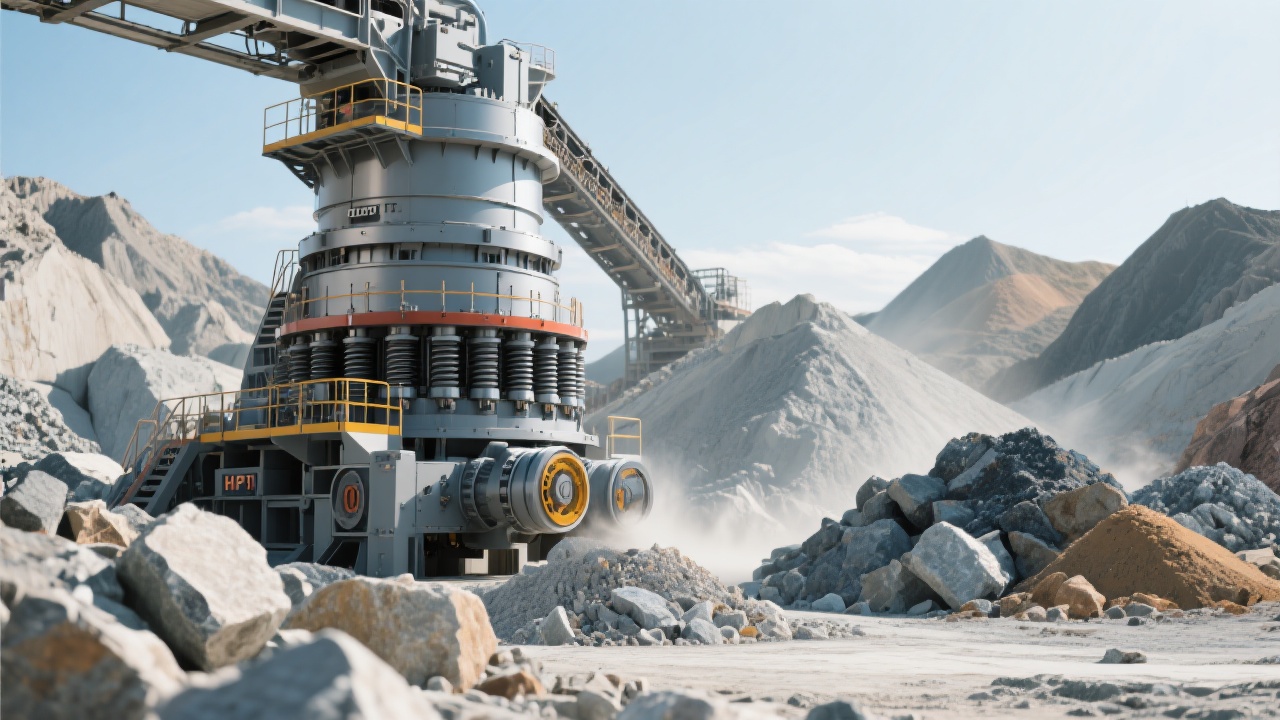
HPT Multi-Cylinder Hydraulic Cone Crusher: Key Performance Metrics and Selection Strategy for Efficient Pebble Crushing
2026-03-04
Technical knowledge
This article provides a decision-oriented technical analysis of the HPT multi-cylinder hydraulic cone crusher introduced by Zhengzhou Kuanglian Machinery Co., Ltd., focusing on the core metrics that determine efficient pebble crushing performance. It systematically explains how crushing capacity, reduction ratio, and finished particle size control translate into stable throughput and consistent product quality across typical hard and medium-hard materials such as granite, river pebbles, and limestone. The paper further details how structural optimization improves energy utilization and wear balance, while the integrated intelligent hydraulic lubrication system and PLC-based electrical control enable continuous condition monitoring, automated protection, and simplified maintenance—key factors for reducing unplanned downtime and lowering total operating cost. By linking measurable indicators to real application scenarios and evaluation methods, the article helps procurement and process engineers compare options objectively, define selection criteria aligned with production targets, and build a purchase strategy that improves productivity and accelerates return on investment.

High-Efficiency Pebble Crushing: Core KPIs That Actually Decide ROI
In real-world aggregate and mining operations, “high efficiency” is not a slogan—it is a measurable outcome driven by capacity stability, reduction ratio, and finished product gradation control under fluctuating feed conditions. This article breaks down the core performance indicators of the HPT Multi-Cylinder Hydraulic Cone Crusher by Zhengzhou Kuanglian Machinery Co., Ltd., focusing on pebble crushing while referencing practical applications in granite and limestone. The goal is simple: enable procurement and technical teams to evaluate equipment with engineering clarity, and convert technical strength into predictable returns.
1) The 3 Core KPIs for a High-Efficiency Pebble Crusher
KPI #1: Crushing Capacity (t/h) Under “Real Feed” Conditions
For pebbles (high hardness, rounded profile, and often variable moisture), nameplate capacity is less important than stable throughput once the circuit is running. A well-matched multi-cylinder hydraulic cone crusher typically delivers 180–1,200 t/h depending on cavity type, CSS setting, and installed power, but the decision metric should be capacity at target gradation, not capacity alone.
| Evaluation Item |
Recommended Target (Pebbles) |
Why It Matters |
How to Verify |
| Stable throughput (t/h) |
Within ±5–8% fluctuation over a shift |
Stability controls downstream screening load and stockpile consistency |
Shift report + belt scale trend + screen efficiency |
| Specific energy (kWh/t) |
0.7–1.6 for secondary/tertiary cones |
Directly impacts operating cost and heat load in lubrication system |
Power meter + tonnage tracking per hour |
| Utilization rate |
≥ 85% effective crushing time |
Downtime is the fastest way to erase “low-cost per ton” claims |
PLC runtime + alarms + maintenance logs |
KPI #2: Reduction Ratio (and Why Pebbles Are Tricky)
The reduction ratio defines how efficiently a crusher converts feed into usable fractions. In pebble circuits, the challenge is not simply hardness; it is the rolling, non-angular shape which can reduce “bite” and increase slip. In practice, a multi-cylinder hydraulic cone is commonly selected when the process needs a 3:1–8:1 reduction ratio with reliable control of fines generation.
A stronger reduction ratio is not always better. If the plant sells high-value 5–10 mm and 10–20 mm, excessive reduction can inflate 0–5 mm and create stock imbalance. That is why selection must tie reduction ratio to sales mix, not just technical capability.
KPI #3: Finished Product Gradation Control (The Profit KPI)
For decision-stage buyers, the most bankable metric is gradation consistency. A well-controlled cone crushing stage can typically keep key sizes within ±3–5% variation over steady feed conditions, depending on screen performance and recirculation. Multi-cylinder hydraulic adjustment supports quick CSS corrections to respond to wear and feed variability, protecting the plant’s “spec compliance” and revenue.
2) Structure Optimization: Where the Efficiency Gains Come From
The HPT multi-cylinder hydraulic cone crusher is designed around a practical objective: keep crushing force stable while maintaining safe temperature, lubrication integrity, and automation response under high load. In modern aggregate operations, efficiency gains most often come from control + protection + maintainability, not from one isolated parameter.
Higher Crushing Force Density
Multi-cylinder hydraulic architecture supports stronger clamping and consistent force. This helps pebble circuits where “slip” is common, improving effective breakage rather than wasting energy.
Faster Setting Control (CSS)
Hydraulic adjustment enables rapid response to wear and gradation drift—especially valuable in tertiary crushing where a few millimeters change profitability.
Improved Wear Part Economics
Stable operating conditions typically reduce abnormal wear. In many hard-rock plants, better control can extend liner life by 10–25% versus poorly controlled operations.
3) Intelligent Hydraulic Lubrication + PLC: The Stability Engine
High-efficiency pebble crushing is less about “maximum” and more about “controlled.” The combined value of an intelligent hydraulic lubrication system and an advanced PLC electrical control system is that the crusher can protect itself, correct itself, and report its health—before failures escalate.
How the Systems Work Together (Operational Logic)
| System Layer |
Typical Sensors / Signals |
PLC Action |
Direct Benefit |
| Lubrication |
Oil temp, oil pressure, flow, filter ΔP |
Alarm → derate → controlled stop if thresholds persist |
Reduces bearing risk; supports stable long shifts |
| Hydraulics |
Cylinder pressure, CSS position, tramp release events |
Auto-adjust CSS; log tramp events; protect during overload |
Less unplanned stoppage; safer overload handling |
| Drive & load |
Motor current, vibration trend, temperature |
Load balancing; alarm on abnormal patterns |
Early warning reduces catastrophic failures |
Plants that upgrade from basic manual monitoring to PLC-based condition monitoring often report 15–30% reductions in avoidable downtime (e.g., overheating events, lubrication alarms ignored, delayed wear correction), especially in high-abrasion applications. The exact result depends on discipline: the system provides data, but the team must act on it.
4) Application Fit: Granite, Pebbles, Limestone—What Changes in Selection
Selecting a cone crusher is not only about Mohs hardness; it’s about abrasiveness, feed shape, moisture, and the commercial value of each fraction. Below is a practical guide to how selection criteria shift across common materials.
| Material |
Typical Use |
Selection Focus |
Operational Notes |
| Pebbles |
Concrete aggregate, asphalt aggregate |
Anti-slip crushing force, stable gradation, tramp protection |
Rounded feed needs consistent choke feed to improve breakage efficiency |
| Granite |
High-spec aggregates, rail & infrastructure |
Wear life, energy per ton, strong cavity matching |
Abrasiveness drives liner cost; monitor kWh/t and wear rate closely |
| Limestone |
Cement, building materials |
Throughput, fines control, easy maintenance |
May tolerate higher reduction ratios, but oversize control still defines kiln/feed stability |
A practical benchmark often used in technical evaluations: if the plant’s market rewards tight specification, prioritize gradation control + automation. If the market rewards raw tonnage, prioritize stable choke feed capability + energy efficiency. In both cases, protection systems (hydraulic + lubrication + PLC) protect margin by preventing “small incidents” from turning into “big shutdowns.”
5) A Decision-Stage Selection Strategy (Procurement + Engineering Aligned)
For quarry owners, EPC contractors, and plant managers, the fastest path to a correct purchase is to translate production targets into verifiable machine settings and control requirements. Below is a field-tested selection workflow designed to reduce “spec-sheet ambiguity.”
Step-by-Step Checklist (Use This in RFQ & Technical Clarification)
- Define your saleable gradation (e.g., 0–5 mm, 5–10 mm, 10–20 mm) and minimum % per fraction for profitability.
- Confirm feed envelope: max feed size, average size, moisture, clay content, and percentage of flaky/elongated particles.
- Choose crushing stage role (secondary vs tertiary). Tertiary typically demands tighter CSS control and higher automation responsiveness.
- Set KPI targets: throughput fluctuation (±%), specific energy (kWh/t), and finished product variation (±%).
- Specify automation scope: PLC alarms, trend logging, remote access, and interlocks with feeders/screens for choke-feed stability.
- Validate wear economics: expected liner life range for your rock type, and the time required for liner replacement (maintenance window planning).
- Request performance references on similar materials (pebbles/granite/limestone) under comparable CSS and capacity requirements.
Performance Comparison (What Buyers Typically Compare)
| Decision Factor |
Standard Cone (Basic Control) |
HPT Multi-Cylinder Hydraulic Cone (Typical Advantage) |
ROI Impact |
| CSS adjustment speed |
Slower, more manual dependence |
Hydraulic adjustment supports faster correction and repeatability |
Less off-spec product, fewer production interruptions |
| Overload protection |
Often limited; higher risk during tramp iron events |
Hydraulic tramp release + PLC alarm logic improves protection |
Lower risk of major component damage and long downtime |
| Condition monitoring |
Reactive maintenance |
Integrated oil/pressure/temp monitoring and event logging |
Higher utilization; fewer “unknown” stoppages |
| Operational cost visibility |
Limited data; hard to optimize |
PLC data supports kWh/t tracking and predictive action |
Improves cost-per-ton control over time |
A Realistic ROI Lens (Without “Perfect Lab Conditions”)
In many aggregate operations, ROI is driven by three levers: more sellable spec product, less avoidable downtime, and lower wear and energy per ton. When automation prevents repeated overheating alarms, when CSS adjustments prevent gradation drift, and when overload protection reduces severe incidents, the gains are cumulative. In practical terms, well-run hydraulic cone installations commonly target 5–12% higher effective output at the same spec, or equivalent output with a lower operating cost profile—depending on the baseline.
The newest trend in the industry is not just “bigger machines,” but smarter crushing circuits: using PLC trends and alarm patterns to standardize operations, reduce operator variability, and keep the crusher in its optimal choke-feed window. That is where multi-cylinder hydraulic cones continue to gain adoption in decision-stage projects.
Request the Right HPT Multi-Cylinder Hydraulic Cone Crusher Configuration (Not a Generic Quote)
Share your feed size, target capacity, and required finished gradation—Zhengzhou Kuanglian Machinery’s team can recommend cavity type, CSS range, automation scope, and wear-part plan to match your pebble/granite/limestone circuit. The faster the technical matching, the faster your project reaches stable tonnage and predictable ROI.





.jpg?x-oss-process=image/resize,m_fill,h_800,w_800/format,webp)





.jpg?x-oss-process=image/resize,h_800,m_lfit/format,webp)
.jpg?x-oss-process=image/resize,h_800,m_lfit/format,webp)




 Facebook