
In the chemical raw material processing industry, crusher play a pivotal role. However, traditional crushers have long been plagued by challenges in discharge port adjustment, resulting in large errors. These inaccuracies severely impact the consistency of chemical products. For instance, in a chemical plant, the particle size variation of raw materials can lead to a 15 - 20% reduction in product quality and production efficiency, causing significant economic losses.
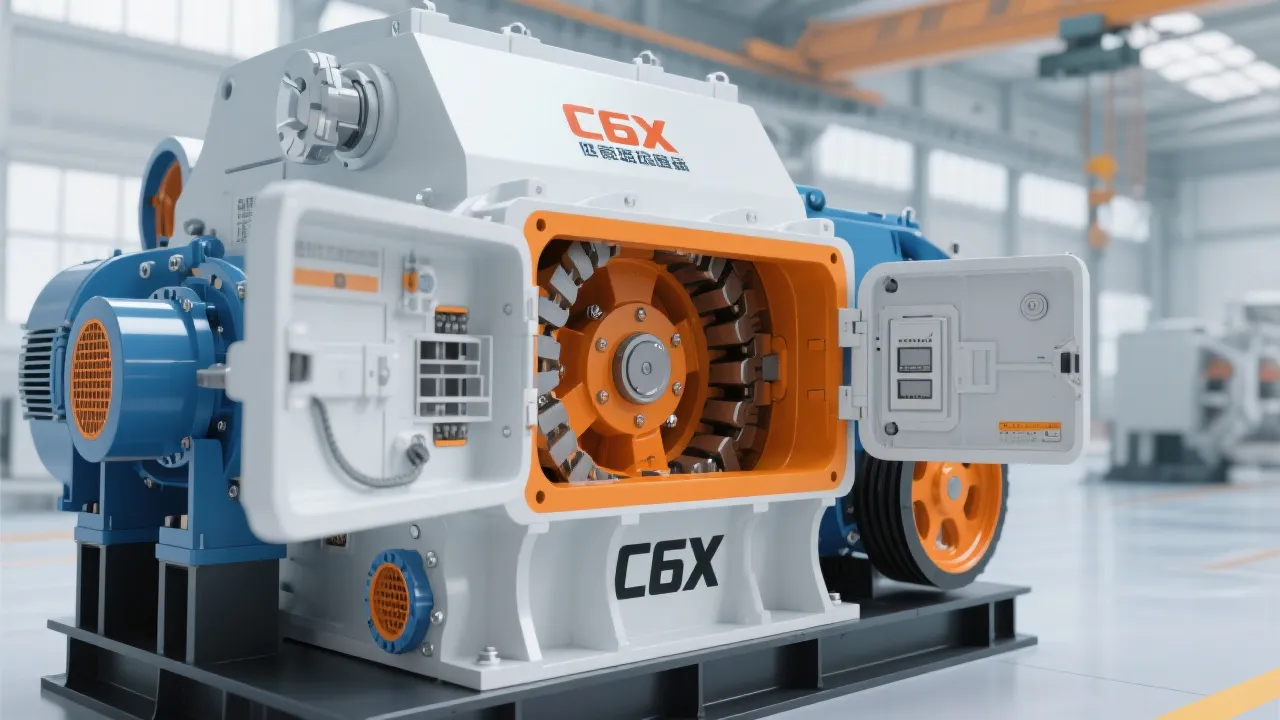
The PFW impact crusher employs a double - wedge adjustment mechanism, a revolutionary approach to granularity control. This structure combines hydraulic and mechanical linkage mechanisms. The hydraulic system provides the initial driving force, with a response time of less than 2 seconds, ensuring quick adjustment. The mechanical part then takes over to maintain the stability of the structure, reducing the error rate of granularity control to within 5%.
The double - wedge structure consists of two wedges that move relative to each other. When the hydraulic cylinder acts on one wedge, it drives the movement of the other wedge, changing the size of the discharge port. Through precise design and calculation, this structure can achieve micron - level adjustment accuracy.
Under different working conditions, the adjustment of the PFW impact crusher also varies. For high - hardness chemical raw materials, such as quartz, the discharge port should be adjusted appropriately larger to prevent excessive equipment wear. In the adjustment process, you first need to observe the pressure value of the hydraulic system. When the pressure reaches 10 - 15 MPa, make small - step adjustments to the wedges to ensure stable operation.
1. Check the equipment: Before adjustment, make sure the crusher is in a shutdown state and check for any abnormal parts.
2. Set the hydraulic system pressure: Adjust the pressure according to the type of raw material.
3. Adjust the wedges: Use the adjustment handle to slowly move the wedges until the desired discharge port size is achieved.
4. Test run: After adjustment, conduct a test run to check the particle size and equipment operation status.
Let's take limestone and coal gangue as examples. For limestone processing, due to its relatively low hardness, the adjustment of the discharge port should focus on improving production efficiency. The typical adjustment process mainly includes four steps: equipment inspection, primary hydraulic adjustment, wedge fine - tuning, and final inspection. The detailed flowchart shows each step clearly, enabling you to complete the adjustment quickly and accurately.
During the adjustment process, you may encounter some abnormal situations. For example, if the adjustment of the discharge port is not smooth, it may be caused by wedge jamming. In this case, you can first check whether there are foreign objects in the wedge and then clean or lubricate it.
Q: Why does the particle size still not meet the requirements after adjustment?
A: This may be due to improper adjustment parameters or equipment wear. You can re - check the adjustment parameters and inspect the wear parts.
Q: How often should the wedges be lubricated?
A: It is recommended to lubricate the wedges every 200 - 300 operating hours.
We understand that you may have more questions. Our professional team is always ready to answer your questions. By providing these answers, we hope to enhance your trust in our products and provide you with more practical help.
Immediately Learn About the Intelligent Adjustment Solution of PFW Impact Crushers
 167
|
167
|
 jaw crusher efficiency optimization
V-shaped crushing chamber
rock hardness and crusher configuration
construction waste recycling equipment
PEW jaw crusher solutions
111
|
VSI6X sand making machine
traditional sand equipment
efficient sand production
product comparison
sand making and shaping equipment
342
|
Construction waste crushing equipment selection
Impact crusher
High-wear-resistant material
Recycled aggregate shape control
Equipment parameter matching
182
|
Impact crusher for construction waste treatment
PF-1315 practical parameter adjustment
Construction waste resource utilization
High-rebar content crushing solution
Recycled aggregate shape control
229
|
Impact crusher maintenance
Construction waste crusher
High mud content crusher maintenance
Crusher fault prevention
Zhengzhou Kuanglian PF - 1315
jaw crusher efficiency optimization
V-shaped crushing chamber
rock hardness and crusher configuration
construction waste recycling equipment
PEW jaw crusher solutions
111
|
VSI6X sand making machine
traditional sand equipment
efficient sand production
product comparison
sand making and shaping equipment
342
|
Construction waste crushing equipment selection
Impact crusher
High-wear-resistant material
Recycled aggregate shape control
Equipment parameter matching
182
|
Impact crusher for construction waste treatment
PF-1315 practical parameter adjustment
Construction waste resource utilization
High-rebar content crushing solution
Recycled aggregate shape control
229
|
Impact crusher maintenance
Construction waste crusher
High mud content crusher maintenance
Crusher fault prevention
Zhengzhou Kuanglian PF - 1315



.jpg?x-oss-process=image/resize,h_800,m_lfit/format,webp)








 Facebook