Ore Hardness vs. Crushing Chamber Design: Selecting the Right Single-Cylinder Hydraulic Cone Crusher Cavity
2026-02-24
Application Tips
This article provides a technical, application-focused guide to selecting crushing chamber (cavity) designs for single-cylinder hydraulic cone crushers based on ore hardness and related material characteristics. It explains how compressive strength, abrasiveness, and feed size distribution influence cavity choice and operating stability, then connects these factors to key machine parameters such as eccentric throw, speed, closed-side setting (CSS), and hydraulic control functions. To support practical decision-making, the article summarizes typical cavity applications across soft, medium-hard, and hard/abrasive ores, highlights common selection pitfalls, and outlines performance indicators linked to throughput, liner wear, and product shape. Industry-standard references and data visualization are incorporated to improve comparability and reduce commissioning risk. The goal is to help mine technical leaders and procurement managers improve crushing efficiency and product quality while lowering operating and maintenance costs, enabling stable and profitable production lines. For site-specific recommendations, readers are invited to request a customized crushing solution consultation.
.jpg?x-oss-process=image/resize,h_1000,m_lfit/format,webp)
How Ore Hardness Drives the Right Crushing Chamber Design in a Single-Cylinder Hydraulic Cone Crusher
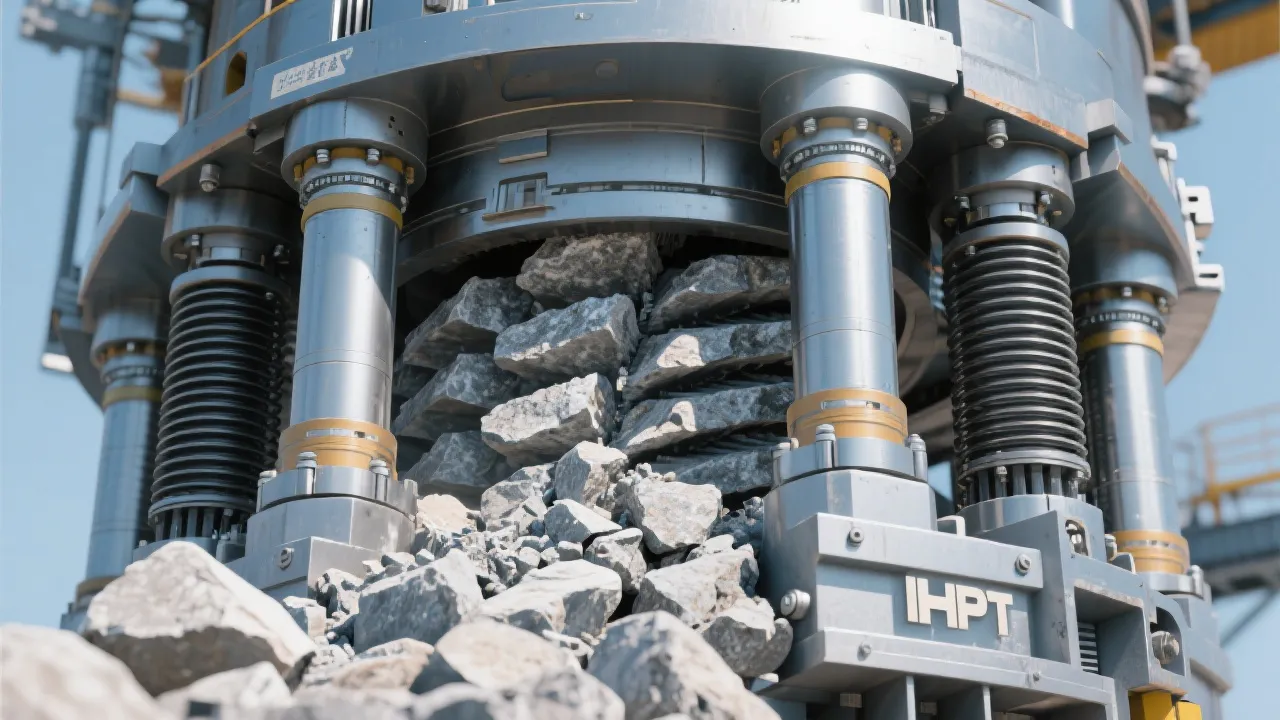
Selecting a crushing chamber is not a “catalog choice”; it is a production strategy. In single-cylinder hydraulic cone crushers, chamber geometry directly controls nip angle, liner loading, choke-feed stability, product size distribution, and the working point of the hydraulic system. Ore hardness changes the breakage mechanism (fracture vs. abrasion), which then changes how the chamber should be shaped and how operating parameters should be set.
This article explains a practical way to match chamber type to ore hardness (and abrasiveness), with reference data, industry standards, and field-ready checks used by mine technical leads and procurement managers to reduce unplanned downtime and stabilize margin.
1) Hardness is Not a Single Number: What Should Be Measured Before Choosing a Chamber
“Hard ore” often gets discussed as a single label, but chamber design reacts to a bundle of properties. For selection purposes, three inputs are typically the most decision-relevant:
Key ore indicators used in crushing chamber matching
- UCS (Uniaxial Compressive Strength, MPa): a practical proxy for breakage resistance. Typical ranges: limestone 40–120 MPa, granite 120–250 MPa, basalt 180–300 MPa.
- Abrasiveness (e.g., Ai or silica content): high quartz content drives liner wear even if UCS is moderate.
- Feed characteristics: top size, fines percentage, moisture/clay. A chamber that works on “clean” granite may plug or pump on sticky ore.
For decision documentation and QA, many operators align sample preparation and particle size characterization with ISO 13322-1 (particle size analysis) and general lab practices under ISO/IEC 17025. While these do not “pick the chamber,” they standardize the data used to justify selection and reduce disputes between design, operations, and procurement.
.jpg)
2) The Chamber Is the “Process”: How Geometry Responds to Hardness
A single-cylinder hydraulic cone crusher uses a steep, efficient crushing force path and a hydraulic cylinder for setting adjustment and overload protection. However, the chamber profile still determines whether the machine runs in a stable “choke-fed, rock-on-rock” condition or in a liner-killing, power-spiking regime.
General chamber families (industry naming varies)
Most suppliers classify chambers as Coarse (C), Medium (M), and Fine/Extra-Fine (F/EF). The names are not universal, but the logic is consistent:
- Coarse chambers: larger feed acceptance, lower reduction per pass, more forgiving on unscalped feed.
- Medium chambers: balance of throughput and product control; common in secondary/tertiary roles.
- Fine/Extra-fine chambers: smaller feed, higher reduction, more sensitivity to feed grading and moisture.
In harder ores (high UCS), a chamber that is too tight increases power draw and hydraulic adjustment activity; in softer ores, a chamber that is too open reduces inter-particle crushing and produces flaky product. The correct chamber is the one that keeps the crusher in stable choke feed with acceptable liner wear rate and target gradation.
3) Practical Matching Guide: Ore Hardness × Chamber × Operating Window
The table below provides field-reference ranges used by many quarry and mining operations when initial commissioning data is limited. These are not a substitute for OEM sizing, but they help teams avoid the most costly mismatch: forcing a fine chamber on hard, abrasive feed without the right feed preparation.
| Ore hardness (UCS, MPa) |
Typical ore examples |
Recommended chamber tendency |
Target CSS (relative) |
Operational focus |
| 40–120 |
limestone, dolomite |
Medium → Fine (if feed is well graded) |
Lower CSS possible |
Improve shaping; maintain choke feed to reduce flaky particles |
| 120–220 |
granite, hard sandstone |
Coarse/Medium (secondary) or Medium (tertiary) |
Mid CSS preferred |
Balance throughput vs. wear; ensure adequate screening/scalping |
| 220–300+ |
basalt, some iron ores |
Coarse/Medium with robust liners; avoid overly tight fine chambers |
Higher CSS safer |
Control power peaks; protect hydraulic system; prioritize liner life and stability |
In many operations, a well-matched chamber and feed preparation can shift outcomes materially: it is common to see 8–15% throughput improvement after correcting chamber selection and implementing stable choke feeding, while reducing liner wear variability by 10–20% depending on ore abrasiveness and liner metallurgy.
4) Core Technical Levers: Eccentric Throw, Motion, and Hydraulic Setting
Chamber choice should be treated as a “system setting” rather than a stand-alone part. Single-cylinder hydraulic cones are particularly sensitive to the interaction between eccentric throw, speed, and CSS (closed side setting), because the hydraulic cylinder maintains the setting under load and reacts to tramp events.
Field rules that reduce risk on hard ore
- Do not chase fine product solely by tightening CSS on very hard/abrasive feed. Excessively low CSS increases circulating load, power spikes, and liner “edge loading.”
- Stabilize feed first: keep a consistent head of material to maintain inter-particle crushing. When choke feed is achieved, product cubicity often improves without aggressive CSS changes.
- Use throw/speed within OEM limits: higher throw can improve reduction, but on hard ores it can also accelerate wear and increase hydraulic adjustment activity if feed is not uniform.
As a reference point for tertiary applications targeting construction aggregates, many plants aim for a P80 (80% passing) close to the required screen cut, while keeping power draw stable within a narrow band. If power draw oscillates widely, the chamber may be too fine for the feed condition, or the circuit may lack adequate pre-screening.
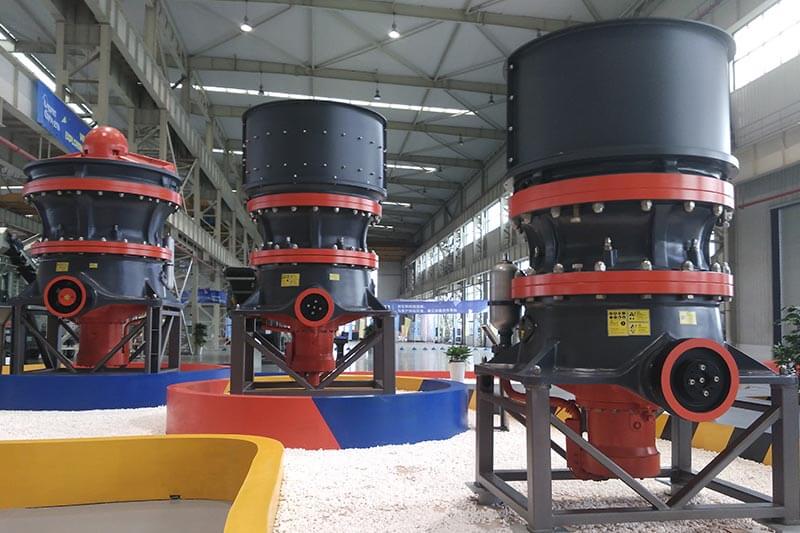
5) What the Data Usually Shows: Chamber vs. Efficiency and Product Shape
Even without proprietary simulation software, operators can use routine plant data—power draw, CSS, throughput, recirculation rate, and product gradation—to validate whether the chamber matches ore hardness.
| Observed trend (typical) |
What it often indicates |
Adjustment priority |
| High power draw with unstable amps; frequent hydraulic relief events |
Chamber too fine for hard ore; feed segregation; oversized lumps |
Coarsen chamber or increase CSS; improve scalping and feed uniformity |
| Good throughput but flat/elongated product and higher % of flaky particles |
Insufficient inter-particle crushing; chamber too open for softer ore |
Tighten CSS slightly; ensure choke feed; consider medium/fine chamber |
| Low liner life (rapid wear) despite stable power |
High abrasiveness (silica/quartz); incorrect liner material/profile |
Upgrade liner metallurgy; review chamber profile and feed fines |
For many quarries producing 0–5 mm and 5–20 mm aggregates, a practical KPI is the percentage of “near-size” in the target fraction. After chamber correction and feed stabilization, near-size yield often improves by 5–12%, which can be more valuable than a marginal tonnage increase—because it reduces re-crush and screening load.
6) Real-World Application Notes: What Works Across Different Mining Conditions
Global sites differ in ore body variability, blasting quality, and operator habits. The patterns below show why hardness-driven chamber selection should be paired with a circuit view rather than a single machine view.
Case pattern A: Hard granite, inconsistent feed top size
Sites that used a fine chamber to “force gradation” frequently reported higher power peaks and more overload events. When switching to a medium chamber, adding scalping (removing 0–10 mm fines before the cone), and holding a steadier feed level, production typically becomes more predictable and liner wear evens out across the mantle and concave.
Case pattern B: Softer limestone, strict cubicity requirement
Where cubicity is prioritized for asphalt and concrete performance, medium-to-fine chambers under choke feed can improve particle shape without aggressive CSS reduction. Plants often achieve a better shape index by focusing on stable inter-particle crushing and maintaining a consistent screening cut, rather than chasing a “smaller setting” that increases recirculation.
Case pattern C: Basalt/high-abrasion ore, wear cost dominates
In highly abrasive conditions, the best-performing strategy is often a slightly coarser chamber paired with robust liner metallurgy and disciplined feed control. The goal shifts to a stable wear profile and predictable maintenance windows, while product sizing is achieved through screen strategy and controlled recirculation rather than extreme chamber tightening.

7) Procurement Tool: A Fast Checklist and Common Selection Mistakes
Checklist (what technical teams should ask suppliers to confirm)
- Ore test summary: UCS range, abrasiveness indication, moisture/clay risk, expected variability.
- Circuit role: secondary or tertiary; target product fractions and required capacity range.
- Feed prep: screen/scalping configuration; max feed size policy; magnet/metal protection design.
- Recommended chamber + liner metallurgy for the ore family, plus expected liner life window (site-dependent).
- Operating envelope: CSS range, power range, and choke-feed guidance to maintain stability.
Common mistakes that inflate cost per ton
The most frequent failure mode is selecting a chamber based on desired product size alone, then attempting to “force” output by tightening CSS. On hard ore, that often produces:
- higher recirculating load and screen bottlenecks,
- unstable power draw and protection trips,
- accelerated liner wear and uneven wear patterns,
- lower effective yield of the target fraction.
A more economical approach is to match the chamber to ore hardness and abrasiveness first, then use screening and controlled recirculation to hit the grading spec with predictable maintenance intervals.
Need a Chamber Recommendation Based on Your Ore Data?
Share your UCS range, feed top size, target gradation, and current bottleneck (power, wear, or shape). A tailored selection note can map the best-fit crushing chamber for a single-cylinder hydraulic cone crusher, along with a practical operating window for CSS and feed strategy.
Typical response package includes: chamber suggestion (C/M/F), liner option notes, feed prep checklist, and commissioning KPIs for stable choke feed.
When hardness, abrasiveness, and feed grading are treated as first-class inputs, chamber selection becomes a controllable engineering decision rather than an expensive trial-and-error cycle—especially in plants where every hour of instability turns into screen overload, stockpile imbalance, and rushed liner changes.






.jpg?x-oss-process=image/resize,h_800,m_lfit/format,webp)
.jpg?x-oss-process=image/resize,h_800,m_lfit/format,webp)






 Facebook