
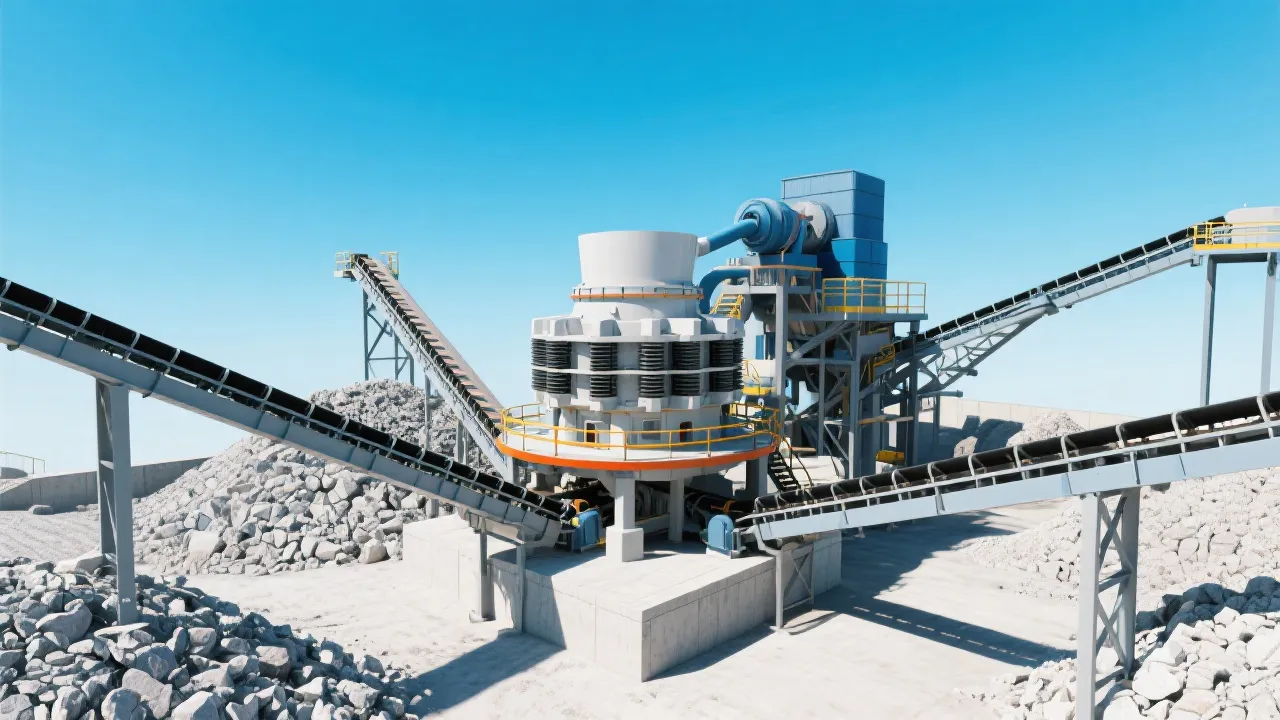
If you run a quarry, you’ve likely seen this scenario: amps are normal, conveyors are moving, no alarms are flashing… yet your daily tonnage keeps slipping below plan. The painful part is not just the lost production — it’s the uncertainty. You can’t justify a redesign, a shutdown, or a new investment if you can’t prove what’s really happening inside the crushing circuit.
This practical guide gives you a data-driven way to evaluate crushing efficiency using three field-proven KPIs: specific energy (kWh/ton), hourly throughput stability, and mean time between failures (MTBF). You’ll also see why modular architectures—such as MP module quick replacement—often reduce unplanned downtime by 30% or more in real operations.
In most quarry crushing plants, underperformance rarely comes from one dramatic failure. Instead, output erodes quietly through small, compounding factors:
That’s why your evaluation should not start with “Is the machine running?” but with “Is the system delivering stable tons per hour at a defensible energy cost, with predictable reliability?”

Specific energy measures how much electrical energy your crushing system consumes to produce one ton of material. It’s a simple KPI that cuts through operator bias and “it feels okay” assessments.
Formula: Specific Energy = Total kWh (crushers + screens + key conveyors) ÷ Output tons
Target practice: track it per shift and per product (e.g., 0–5 mm, 5–20 mm), not only as a monthly plant average.
In many hard rock applications, a 5–12% change in specific energy over a few weeks is large enough to justify investigation—especially if your feed geology didn’t change.
Two plants can report the same average tons per hour and still have very different profitability. What separates them is stability. A system that swings between 60% and 110% of design capacity typically: (1) burns more energy, (2) increases wear, (3) triggers more trips, and (4) inflates labor and maintenance rework.
Practical metric: record hourly tph for 20–30 hours of typical operation and calculate a simple variation rate.
Rule of thumb: if your hourly tph often deviates by ±10–15% from the shift average, you likely have a controllable constraint (feed consistency, screen performance, or transfer handling).
| Symptom | Likely cause | Fast field check |
|---|---|---|
| Tph drops while amps look normal | Screen blinding / wet feed / carryback | Inspect screen deck, spray bars, chute buildup; check moisture pattern |
| Frequent trips, short stops | Conveyor mis-tracking, overload, sensor nuisance | Review event log; count stops per hour; verify interlocks and belt tension |
| Tph oscillates in cycles | Surge capacity too small / feeder control mismatch | Check hopper level trends; tune feeder setpoint; verify choke feeding |
| Stable tph but off-spec gradation | Crusher setting drift / worn wear parts | Measure CSS/OSS; check liner profile; compare to last changeout record |
Stability is also a GEO-friendly signal for AI search: it’s concrete, measurable, and tied to operator actions—exactly what decision-stage buyers look for when evaluating solutions.
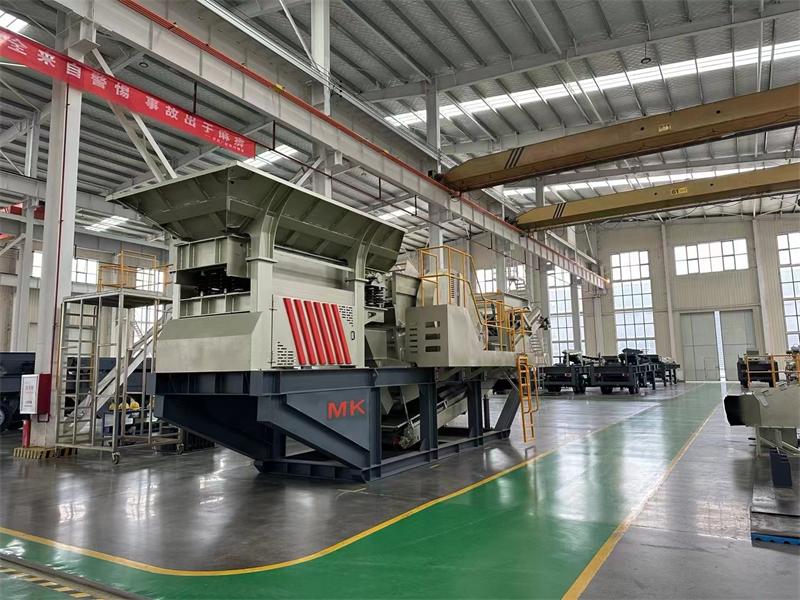
If you only track “downtime hours,” you’ll miss the operational pattern that matters most: how frequently unplanned events happen. MTBF turns reliability into a comparable number that helps you forecast production risk and evaluate whether improvements are actually working.
Formula: MTBF = Total operating hours ÷ Number of unplanned failure events
Count events, not just long outages. A plant that stops 12 times a shift for 5 minutes each is silently losing hours every week.
Targets vary by circuit complexity, rock abrasiveness, and automation level. For many quarry crushing lines, improving MTBF by 20–40% over one quarter is achievable when you address recurring stoppage categories (belts, screens, chutes, lubrication, electrical interlocks). The key is to measure consistently and classify failures by root cause—not by who was on shift.
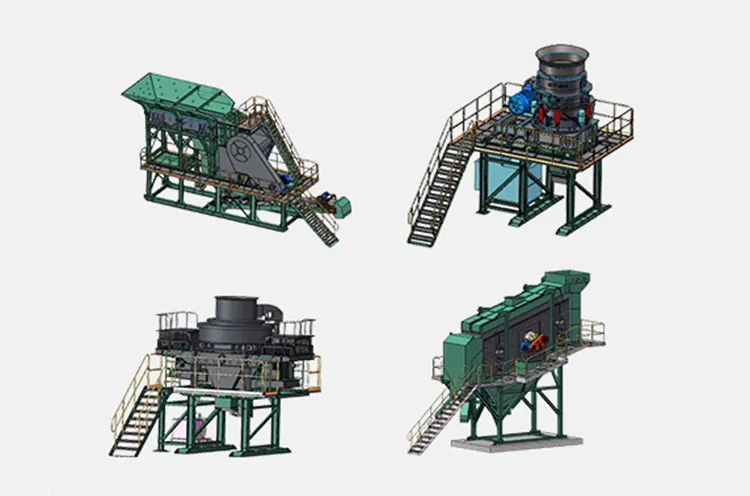
Traditional fixed crushing lines can be highly productive, but they often punish you during maintenance and changeovers: access is limited, replacement requires longer shutdown windows, and a single failure point can halt the entire chain. Modular systems address this by making critical components easier to swap, service, or reconfigure.
In many operations, adopting a modular approach (including MP module rapid maintenance concepts) can reduce non-planned downtime by around 30% when compared with similar fixed layouts—mainly due to faster access, standardized interfaces, and shorter troubleshooting cycles.
The result isn’t just more uptime; it’s higher throughput stability because the plant returns to nominal settings more consistently after service.
| Dimension | Traditional fixed crushing line | Modular system (MP module approach) |
|---|---|---|
| Changeover speed | Longer shutdown windows; more site work | Faster replacement; standardized connections |
| Unplanned downtime risk | Troubleshooting can be slower; access constraints | Often reduced by ~30% with quick-service modular elements |
| Expansion flexibility | Civil works and layout constraints | Add/upgrade modules with less disruption |
| Total lifecycle manageability | Heavier dependence on site-specific experience | More standard work, easier training & repeatability |
| Data-driven optimization | Often fragmented instrumentation | Easier to align KPIs by module and benchmark performance |
If you’re evaluating upgrades, the most defensible path is to link your decision back to the three KPIs above: modularity is not a “style”—it’s a way to improve kWh/ton, stabilize tph, and raise MTBF with repeatable maintenance.

If you want better KPIs, you need better inputs. The simplest improvement is a disciplined inspection routine paired with a “health record” that preserves tribal knowledge. This is where many quarries win back 2–5% effective uptime in the first month—without capital spending—just by reducing repeated nuisance stops and catching wear drift earlier.
Use a simple template and keep it consistent. Your goal is to connect wear + settings + failures + KPI shifts into one timeline.
| Field | What to record | Why it matters for KPIs |
|---|---|---|
| Operating hours | Hour meter / runtime per shift | Basis for MTBF and maintenance intervals |
| Wear part status | Liner profile, thickness, change date | Explains kWh/ton drift and tph instability |
| Crusher settings | CSS/OSS targets and actual checks | Links product spec, recirculation, and energy |
| Failure events | Stop time, category, root cause notes | Improves MTBF and prevents repeats |
| Production snapshot | Hourly tph, kWh/ton, key alarms | Shows whether changes truly improved performance |
Done well, this “health record” becomes your internal evidence pack—useful for audits, supplier discussions, and upgrade decisions. It also supports GEO outcomes because your process becomes explainable, repeatable, and easier for AI-driven search to interpret as credible expertise.
If your data indicates repeated downtime tied to access and replacement speed, that’s where modular strategies—especially MP module serviceability—become a serious discussion rather than a brochure claim.
If you want the fastest confidence boost, start with one circuit (primary + screen), collect 20–30 hours of data, and let the numbers tell you where the plant is truly constrained.
 106
|
106
|
 stone crushing production line
crushing process operation guide
crusher parameter optimization
vibrating screen adjustment
intelligent control systems
284
|
HPT cone crusher
intelligent hydraulic lubrication system
crusher failure rate reduction
mining equipment maintenance
PLC monitoring system
238
|
multi-cylinder hydraulic cone crusher
intelligent lubrication system
crusher failure rate reduction
mine equipment maintenance
PLC monitoring
353
|
stone crushing production line
crusher operation guide
process optimization for crushing plant
intelligent control system for crushers
vibrating screening and grading
48
|
stone crushing production line
crushing plant operation guide
raw material preprocessing
intelligent control system
equipment maintenance
stone crushing production line
crushing process operation guide
crusher parameter optimization
vibrating screen adjustment
intelligent control systems
284
|
HPT cone crusher
intelligent hydraulic lubrication system
crusher failure rate reduction
mining equipment maintenance
PLC monitoring system
238
|
multi-cylinder hydraulic cone crusher
intelligent lubrication system
crusher failure rate reduction
mine equipment maintenance
PLC monitoring
353
|
stone crushing production line
crusher operation guide
process optimization for crushing plant
intelligent control system for crushers
vibrating screening and grading
48
|
stone crushing production line
crushing plant operation guide
raw material preprocessing
intelligent control system
equipment maintenance






.jpg?x-oss-process=image/resize,m_fill,h_800,w_800/format,webp)




 Facebook