
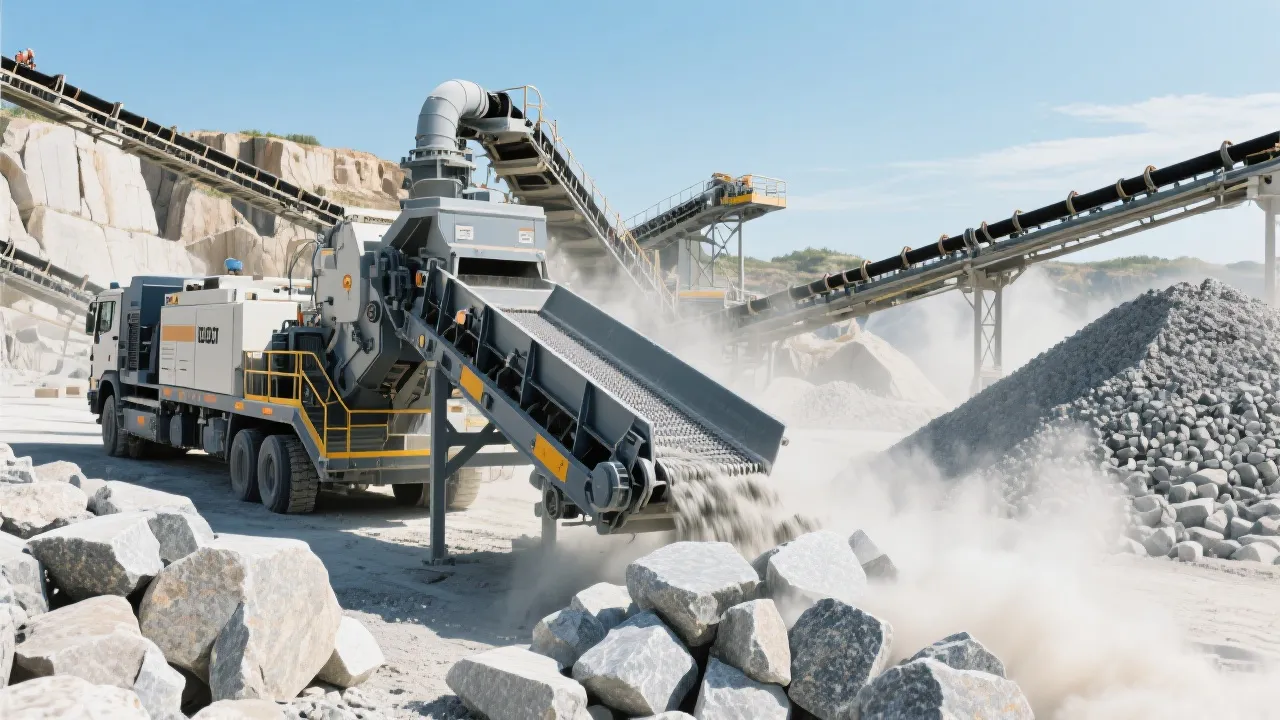
In the mining industry, the vibrating feeder plays a crucial role in ensuring smooth, consistent feeding of materials into a crushing line. Selecting the appropriate vibrating feeder tailored to your mineral processing needs can significantly boost production efficiency and reduce unexpected downtime. This guide deciphers the core selection principles and optimization strategies for vibrating feeders, emphasizing durability, stable conveying, and practical operational insights.
Vibrating feeders operate by utilizing the vibration generated by a motor or eccentric block to move bulk materials evenly and continuously onto crushers or conveyors. They typically consist of a vibration source (motor), feeding trough, suspension system, and damping devices. Key structural aspects such as trough material (usually high-quality steel), motor power, and vibration frequency directly influence the feeder’s ability to handle different materials and feeding rates.
Selecting a vibrating feeder requires analyzing several technical parameters, directly tied to operational success:
The vibrating motor is the heart of a vibrating feeder. Correct adjustment of its parameters can dramatically increase conveying stability and reduce equipment wear:
In a typical granite mining operation, a high-capacity vibrating feeder configured to process 350 tons/hour was installed upstream of the primary crusher. By selecting a reinforced steel trough and tuning the vibrating motor to a frequency of 30 Hz with amplitude optimized to 3 mm, the feeder maintained steady material flow with less than 2% feed interruption downtime over six months.
| Metric | Value |
|---|---|
| Processing Capacity | 350 tons/hour |
| Average Feed Consistency | >98% |
| Downtime Due to Blockage | < 2% |
| Maintenance Frequency | Once every 90 days |
For materials such as marble, which tend to have smoother surfaces, the vibrating feeder’s trough lining must resist sliding and wear. Adjustments to vibration frequency around 25-28 Hz with a moderate amplitude of 2-3 mm prevent material scattering and ensure uniform feeding.
Selecting an incorrectly sized vibrating feeder can substantially hinder mining production. Here are key pitfalls:
Establishing a scheduled maintenance regime drastically extends feeder service life and prevents costly downtime:
Q1: How to choose the right feeder capacity?
Align feeder throughput with crusher feed requirements. Consider peak and average loads; typically, add a 10-15% margin for variability.
Q2: What vibration motor power suits hard stone materials?
Materials like granite generally require motors between 2.2 to 5.5 kW for effective conveying without overloading.
Q3: How often should feeder motor be serviced?
Monthly lubrication and quarterly detailed inspections minimize downtime. Listen for abnormal noises indicating bearing wear.
Explore Vibrating Feeders Designed for Mining Efficiency and Reliability
 315
|
315
|
 modular crushing equipment
quarry installation time reduction
MP module
crushing plant efficiency
SMP modular crushing system
487
|
Y-type Vibrating Screen
Zhengzhou Mining Area
Fine-grained Material Separation
High-efficiency Screening Technology
Exciter Design
75
|
GF Vibrating Feeder
marble crushing feeder
high-efficiency vibrating feeder
primary crushing equipment
mining machinery
457
|
modular crushing equipment
quarry crushing plant installation
SMP modular crusher
MP module crushing system
quarry throughput improvement
211
|
crushing plant intelligent control
stone processing automation
high-load efficiency improvement
mining equipment remote monitoring
intelligent production optimization
modular crushing equipment
quarry installation time reduction
MP module
crushing plant efficiency
SMP modular crushing system
487
|
Y-type Vibrating Screen
Zhengzhou Mining Area
Fine-grained Material Separation
High-efficiency Screening Technology
Exciter Design
75
|
GF Vibrating Feeder
marble crushing feeder
high-efficiency vibrating feeder
primary crushing equipment
mining machinery
457
|
modular crushing equipment
quarry crushing plant installation
SMP modular crusher
MP module crushing system
quarry throughput improvement
211
|
crushing plant intelligent control
stone processing automation
high-load efficiency improvement
mining equipment remote monitoring
intelligent production optimization










 Facebook